
Design Thinking
Design thinking is a human-centric approach to innovation and problem-solving. It encourages empathy, ideation, and experimentation to create user-centered solutions. Everything we do follows this guiding principle.
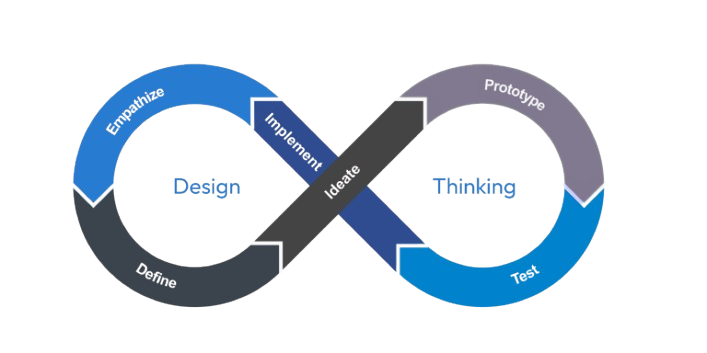
Here are some of the ways we help our clients.
Our Process
Empathize
Conduct user research to gather insightful information about end-users’ needs and problems.
Define
Clearly define the problem based on insights gathered during the first phase.
Ideate
Elosophy creative solutions and encourage divergent thinking to explore various possibilities.
Prototype
Develop a tangible or visual representation of the solution to test its functionality and effectiveness.
Test
Test the prototype with users to gather feedback and learn about its strengths and weaknesses.
Iterate
Iterate and refine the solution to enhance its effectiveness and alignment with user needs.
Best Practices We Implement
Iterative development
Develop a tangible or visual representation of the solution to test its functionality and effectiveness.
User Centric Focus
Conduct user research to gather insightful information about end-users’ needs and problems.
Collaborative work environment
Elosophy creative solutions and encourage divergent thinking to explore various possibilities.
Rapid Prototyping
Clearly define the problem based on insights gathered during the first phase.
Rapid Application Development (RAD)
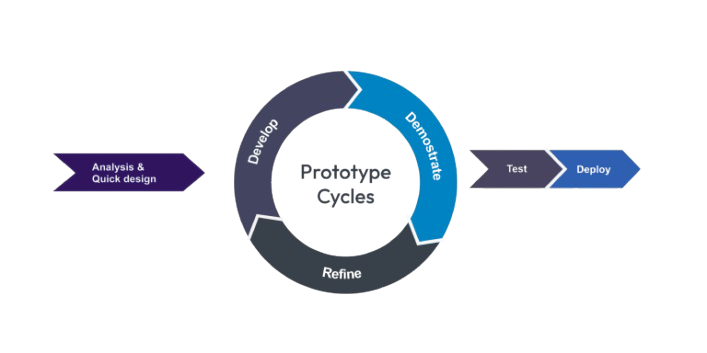
Rapid Application Development (RAD) facilitates swift software development through iterative prototypes and user feedback, making it an excellent choice for projects with undefined or rapidly changing requirements.
Our Process
Requirement identification
Identify basic project requirements.
Prototype Development
Develop initial prototypes to visualize functionalities.
User Evaluation
Obtain user feedback on several prototypes
Refinement
Refine the application based on feedback.
Iterative Development
Repeat the cycle until the product meets the desired standards.
Final Implementation
Implement the final version of the application and launch it
Best Practices We Implement
Modular Design
Adopt a modular design approach for easy changes and adaptations.
User Centric Development
Adjust development based on user research and insights.
Flexible planning
Makes it easier to pivot, and adapt to changing requirements.
Automated testing and integration
Implement automated testing and continuous integration for quality assurance.
Prototype Framework
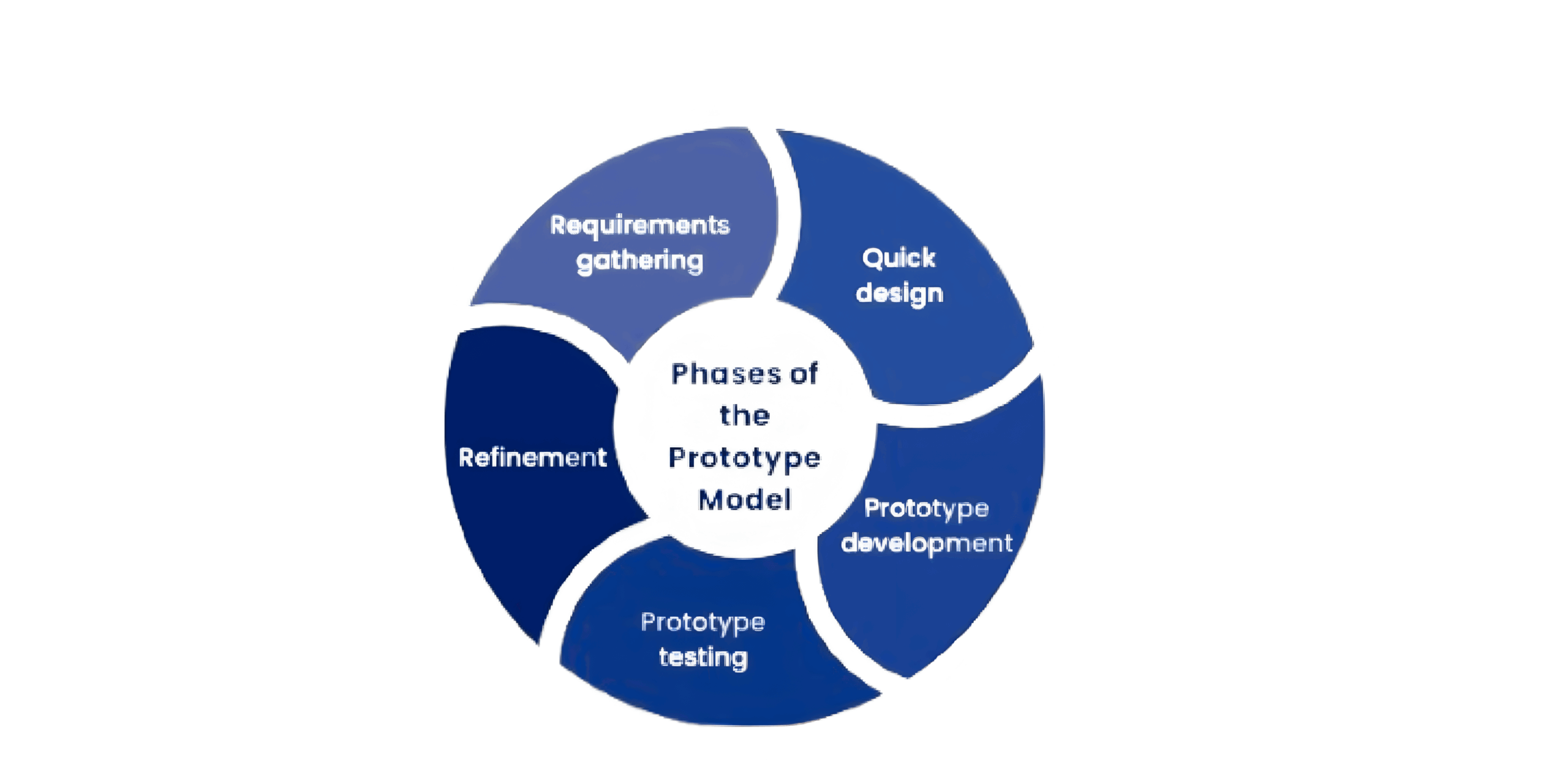
In the prototype framework , a preliminary version of the software is developed to gather user feedback and clarify requirements, which then guides the development of the final product.
Our Process
User evaluation
Collect user feedback on the prototype.
Refinement
Refine the system based on user feedback.
Iteration
Repeat the process until the system meets the user’s expectations.
Initial prototype development
Develop a preliminary software version focusing only on the visual features.
Final development
Develop and refine the final software version based on the information gathered from the initial prototype.
Requirement Identification
Identify initial project requirements.
Best Practices We Implement
User involvement
Actively engage users to gather relevant feedback.
Iterative Development
Embrace iterative development to continuously improve the prototype.
Flexible Design
Maintain a flexible design and modular approach to easily accommodate changes.
Feedback Integration
Integrate feedback effectively to align the product with user expectations.
SAFe
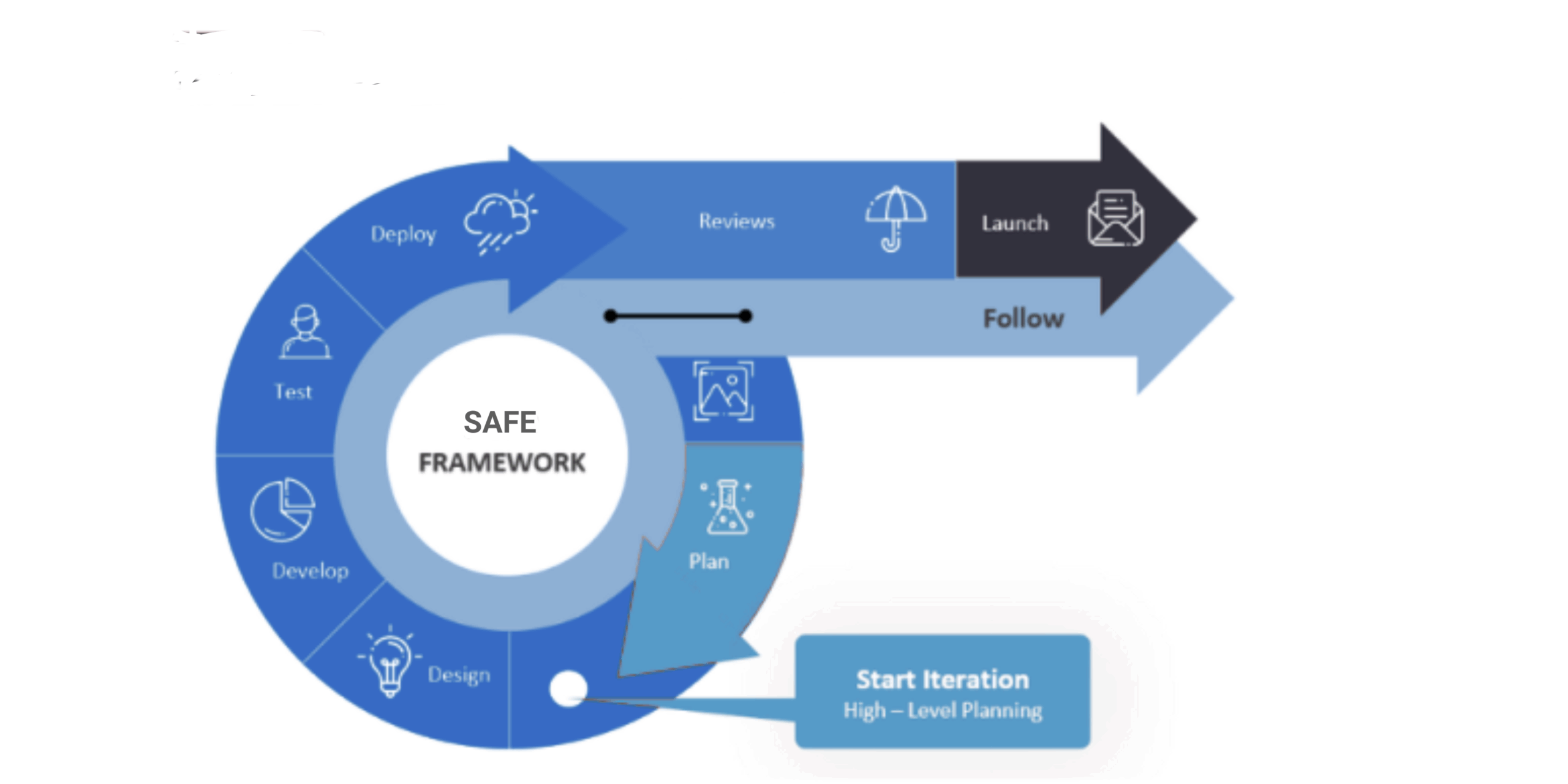
The Scaled Agile Framework (SAFe) is a set of organizational and workflow patterns for implementing agile practices at an enterprise scale. The framework is a body of knowledge that includes structured guidance on roles and responsibilities, how to plan and manage the work, and values to uphold.
Our Process
Alignment
Planning and synchronization at all levels ensure everyone moves in the same direction toward common goals.
Built-in Quality
Quality is never compromised very task has a clear “Definition of Done” with strong development standards.
Transparency
Small batches, real-time visibility, and inspect-and-adapt cycles build trust and maintain clarity.
Program Execution
The core of SAFe—teams must regularly deliver valuable, high-quality, working software.
Collaboration
Cross-functional teams work together and achieve more efficient outcomes.
Innovation
Continuous improvement and experimentation help test new ideas for better business results.
Best Practices We Implement
Take an Economic View
Make decisions based on economic impact by sequencing jobs for maximum value. Operate within lean budgets and share financial responsibility across the organization.
Apply Systems Thinking
View the solution, enterprise, and value streams as a connected system.
Understand how changes in one area affect the others holistically.
Assume Variability, Preserve Options
Keep multiple design and requirement options open early in development.
Use real data to narrow down the best option as the solution evolves.
Incremental Builds & Fast Feedback
Deliver in small increments and validate through regular integration points.
This reduces risk and helps assess system-level feasibility faster.
Scrum
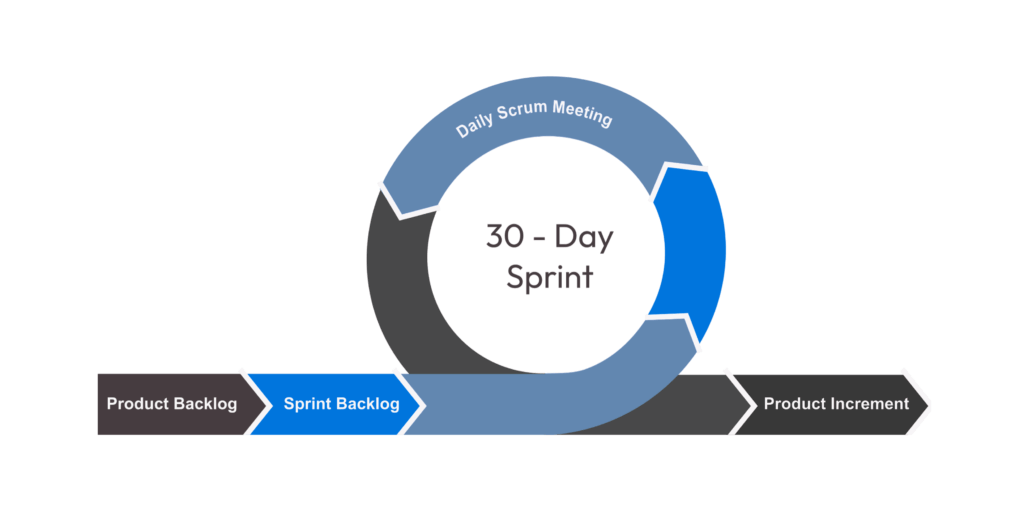
Scrum is a flexible and iterative Agile framework that’s ideal for managing complex software and product development using incremental progress through sprints. It is best suited to projects where requirements might change rapidly and there is a need for frequent adaptations. All of our teams are led by a certified Scrum Master and Product Owner.
Our Process
Sprint planning
Prioritize and select backlog items for the next sprint.
Sprint
Execute tasks with timeboxing (typically within 2-4 weeks).
Daily scrum
Conduct daily team meetings to ensure alignment and discuss progress and roadblocks.
Sprint review
Evaluate the output and present it to stakeholders.
Sprint retrospective
Reflect on the process and make necessary adjustments for future sprints.
Requirement Identification
Identify initial project requirements.
Best Practices We Implement
Continuous Integration
Merging and automatically testing code changes to maintain quality and consistency.
Automated testing
Implement automated testing when possible for faster, more reliable test execution.
Regular reviews
Conduct code and design reviews to encourage collaboration and knowledge sharing among team members.
Definition of Done
Clearly define what “done” means for each user story to ensure a shared understanding of completeness.
Scaled Agile Nexus
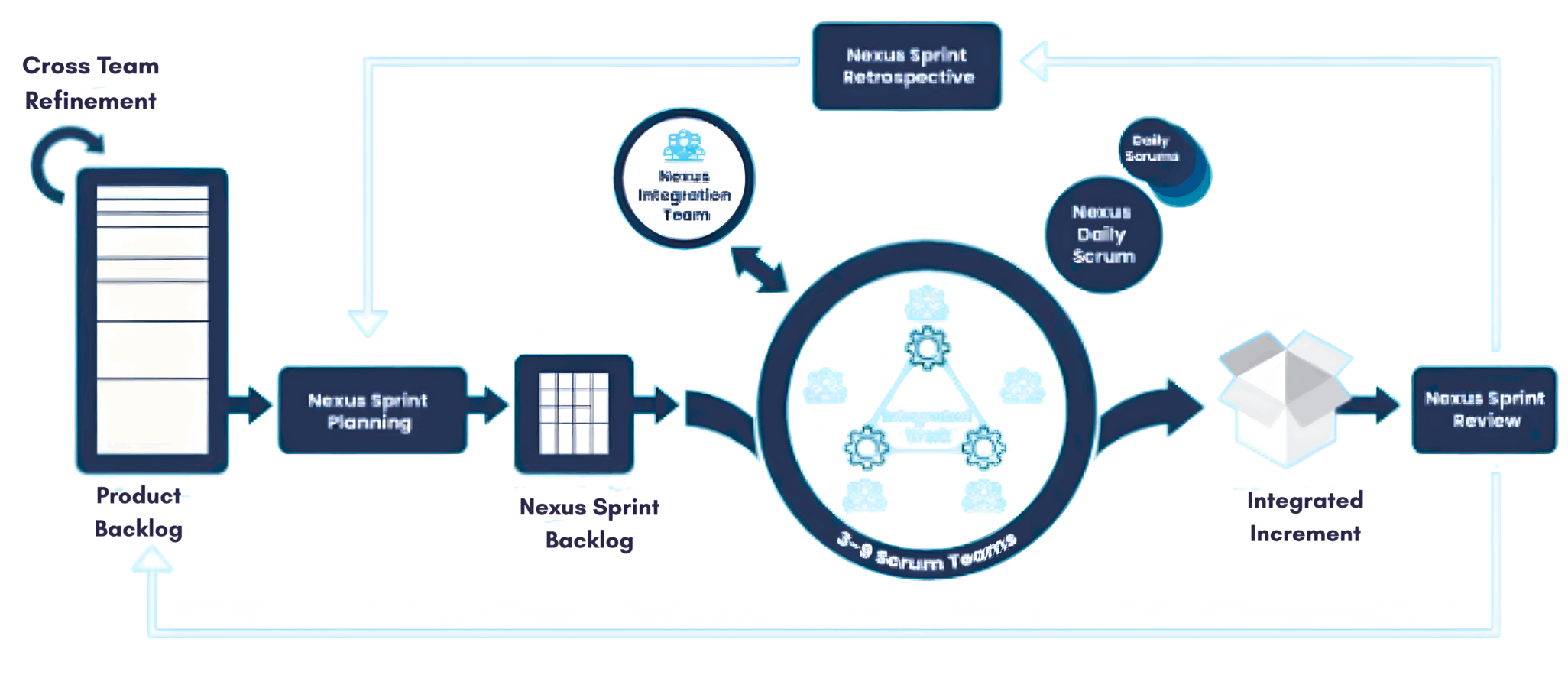
Nexus is a process framework for multiple Scrum Teams working together to create an Integrated Increment. Nexus is consistent with Scrum and its parts will be familiar to those who have used Scrum. The difference is that more attention is paid to dependencies and interoperation between Scrum Teams, delivering at least one “Done” Integrated Increment every Sprint.
Our Process
Team Accountability
The Nexus Integration Team ensures the successful delivery of a fully integrated, high-quality, and valuable Increment at the end of each Sprint by guiding collaboration.
Event Synchronization
Nexus events enhance or replace standard Scrum events to support coordination across teams. Nexus Sprint Goal aligns efforts toward a shared objective.
Unified Planning
All teams work from a single Product Backlog. A Nexus Sprint Backlog provides transparency and helps track which team will handle each item.
Increment Integration
Teams collaboratively integrate their work into a single Integrated Increment every Sprint, representing all completed and tested work.
Cross-Team Refinement
Teams collaboratively refine Product Backlog items to improve clarity, ensuring smooth handoffs and shared understanding.
Scaled Retrospective
Conduct joint retrospectives to uncover cross-team inefficiencies, align on action items, and implement process enhancements at scale.
Best Practices We Implement
Product Goal
Describes the desired future state of the product and acts as a strategic target, guiding Product Backlog refinement and overall team direction.
Nexus Sprint Goal
Establishes a single, unified objective for all Scrum Teams in the Nexus, promoting collaboration, and shared purpose throughout the Sprint.
Integrated Increment
Represents all completed work from every team in the Nexus during the Sprint, ensuring it contributes toward the overarching Product Goal.
Definition of Done
Outlines shared quality standards that must be met for every Integrated Increment to be considered complete, usable, valuable, and ready to deliver.